
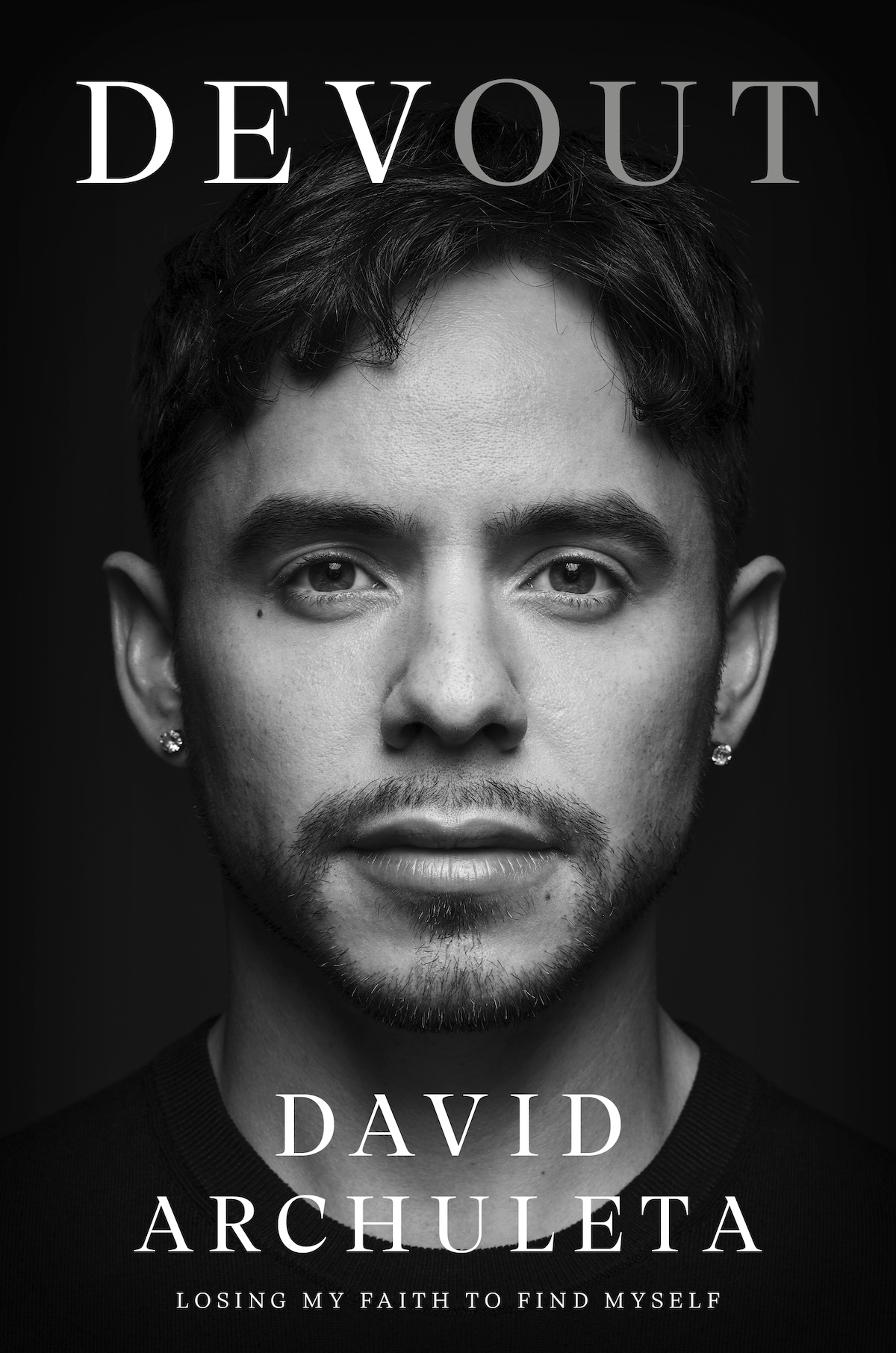
David Archuleta’s memoir, Devout, is about coming out and his personal journey of self discovery, but queer acceptance is only part of the many revelations the chart-topping singer shares in this refreshingly raw account of his rollercoaster life. Archuleta dealt with a turbulent family dynamic that loomed over his success for years, as well as the weight of expectations thrust upon him as a member of the Church of Jesus Christ of Latter-Day Saints, informally known as the Mormon Church.
He was struggling with both when he was thrust into the spotlight and became one of the most beloved contestants in “American Idol” history, garnering millions of fans during the show’s height. Though he took first runner-up (losing to David Cook) in 2008 during the show’s seventh season, the exposure led to a successful music career—which the Mormon church saw as an opportunity to promote its teachings.
But there was one big problem. As Archuleta matured, he started to realize he was attracted to other males, something he struggled to accept in context of his religious beliefs as a young man. Eventually, he could no longer suppress how he felt. When he finally came to terms with his sexuality, the church asked him to conceal it, a request that made him question everything he believed in.
“When I came out, it shocked them, but they wanted me to stay. So they said, ‘do what you want, but don’t be public…keep it to yourself,” he tells me. “I felt like that wasn’t right. That was part of what started deconstructing things in my head, unraveling things. I realized that they were not what they told me they were all my life. It was supposed to be about honesty and representing God, but they wanted to keep secrets just so that I could look a certain way.”
Archuleta felt used. Other church members were excommunicated and kicked out for being gay, but his high profile was valuable to church leaders. The hypocrisy was glaring and he soon realized that living “two lives was not gonna work,” he says. “If I started dating, people would eventually find out.”
The now-35-year-old came out publicly in 2021 and left the church the next year. Compounding his mental health struggles as a child, Archuleta also details how a rift within his extended family and friends led to false sexual abuse accusations against his father.
“They traumatized us,” he says of the accusers, who put his sisters at the center of the deceit. “These are people who supported our dad being taken away from us and put into prison for something that was never confirmed. We had to gaslight ourselves about it.”
Archuleta—whose parents are Honduran—was born in Miami but moved to Salt Lake City (his dad’s hometown) when he was a kid. Cultural norms about respecting elders no matter what made the situation worse, but he and his sisters fought for truth and got past the fabricated stories. He says he couldn’t delve into the full scope of this incident in the book for legal reasons, but it was a formative experience that set the tone for how he accepted mistreatment later.
His parents had split just before he tried out for the hit singing competition at 16 years old, and once he was on TV every week, becoming a household name, his relationship with his controlling stage-dad became untenable. His father was even banned from the set weeks before the season finale.
Archuleta still seems conflicted when he thinks back to his “Idol” beginnings. “It was a great time because of the platform it gave me, but if I look at it from a personal perspective, like the emotions I felt, I hated it,” he admits. “It was like being treated like a zoo animal… I was just trying to find peace with my parents and get along with my dad.”
Even his performance choices on the show reflected the struggle he was dealing with behind the scenes. “I’m singing songs like, ‘Imagine,’ trying to find some grounding during this chaotic time in my life,” he explains. “I just wanted peace and I didn’t care how I got it. If it meant leaving the show sooner, great.”
From Clay Aiken (season 2) to Adam Lambert (season 8) “Idol” contestants have had to make decisions about concealing their sexual preferences while on the show, but young Archuleta was still figuring it out during his time there, grappling with feeling like a “sinner” and fearing what his family might think. He also dated girls and was even engaged multiple times.
Making friends and finding people to connect with was a saving grace. After a guest spot on the hit Nickelodeon show “iCarly,” he became friends with its star Jennette McCurdy, who was also raised Mormon and dealt with the same pressures. “I think we both had the similarity of our parents living vicariously through us, too,” he says. (Years later, McCurdy encouraged him to write the book to help process his past, as she did with her own best-selling memoir).
Overall though, his early days of stardom were rough. “All the hype was a lot for me and the pressure of being in a competition was too much sometimes,” recalls the singer, who scored a hit song, “Crush” after the show wrapped. “You’re getting praised but you feel so horrible about yourself. At the time, I was not in a place to receive it, but now I feel like I’m finally able to.”
He says his relationship with his parents—who also left the church—is mostly healed, and the book has helped him come to terms with his past. He is currently not part of any congregation or religion, and is single as he continues to work on himself. But telling his full story in Devout is about more than his own catharsis.
“My hope is that conversations are had, especially within the church community,” he shares earnestly. “My ultimate goal is to say, ‘hey, there is space for queer people to exist within the Latter Day Saints community. For same-sex couples, there is space for them, and there is a way to do it that still honors their beliefs, which I talk about in the book.”
“Personally, I just want to continue to flourish, thrive, be myself, and be happy,” Archuleta says, exuding a confidence and peace he never achieved as a teen sensation. “It’s so exciting to live my life now… it feels like I was born again.”
‘Devout: Losing My Faith to Find Myself’ (Gallery Books) is out now. Audiobook streams also feature an accompanying EP with songs inspired by the memoir.
Leave a comment