
It’s a sunny afternoon in Los Angeles, and Jordan Benjamin, the artist known as Grandson, is relaxed outside his favorite local coffee spot. He’s sitting at a small table right on the sidewalk, talking about his newest album, when his least favorite neighbor comes rolling up behind him.
When he turns and looks over his shoulder, he sees it: an autonomous delivery robot, a bucket on wheels, with big circle-shaped lights that look like eyeballs. “Oh man, not this fucking thing,” he says as it approaches. “Just watch the way that it makes everyone else move. You’re walking down the sidewalk and this thing comes up and it makes you feel like property is worth more [than people].”
As it rolls past, he says, “I hate you, autonomous delivery robot. I hate these fucking things, dude.”
As it happens, on Grandson’s new album, Inertia, is a song literally called “Autonomous Delivery Robot.” It’s a tense rock track, with heavy, bristling guitars, as Benjamin rhymes with a mechanoid snarl about delivery robots, self-driving cars, airport retinal scans, and electronic privacy: “Corporatize the monopoly / Now the internet’s no longer a democracy / And my digital footprint follows me / So I can never outrun the autonomous delivery robot!”
It’s just one subject that has him raging through the album’s 10 hard-rocking songs, with lyrics that are politically charged and impatient for social justice.
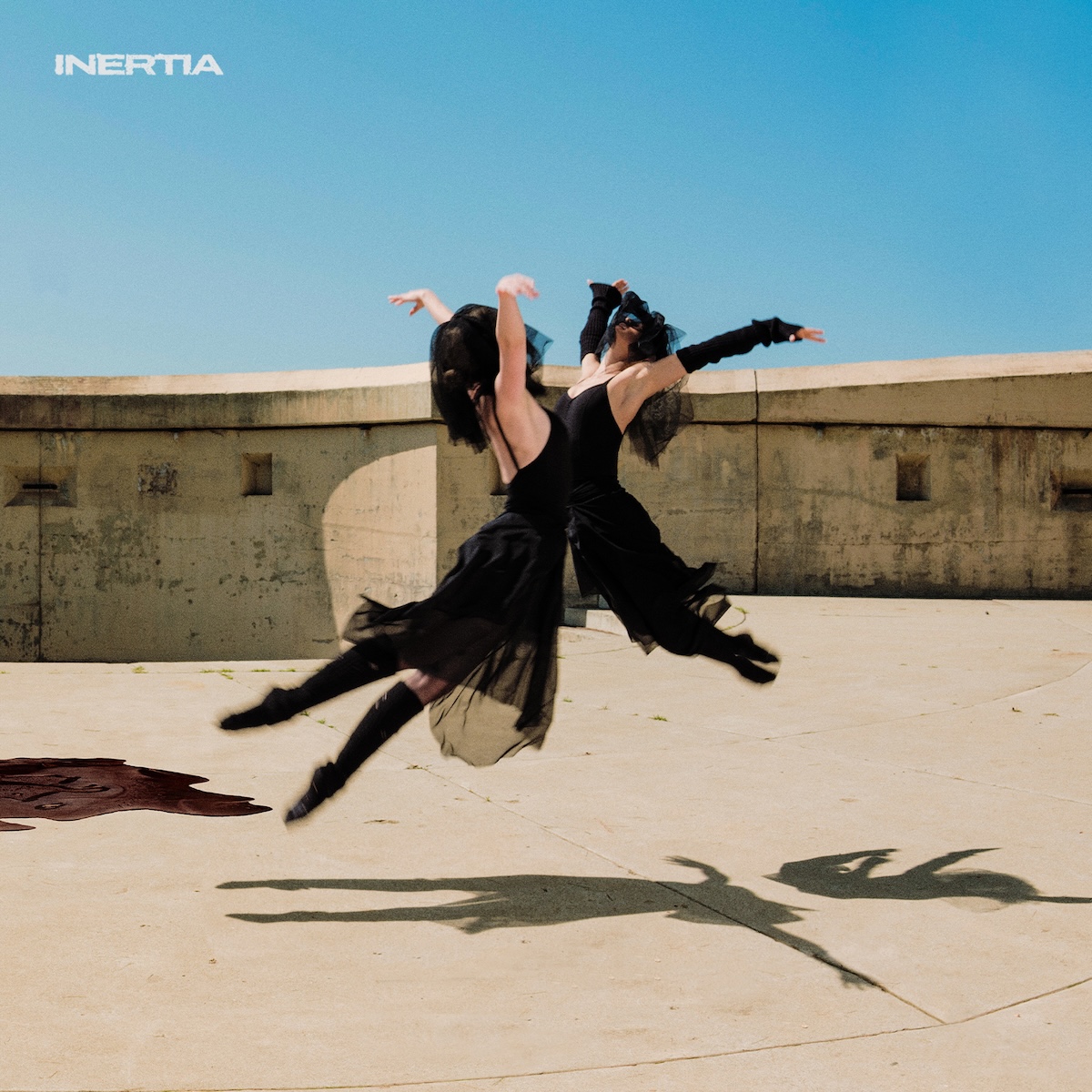
While his previous album, 2023’s I Love You, I’m Trying, turned more inward to explore a period of mental health recovery, Inertia seethes with righteous indignation on the state of society. These are not new issues for Grandson, who has dealt with multiple public crises—from human rights to climate change and voting rights—ever since his 2020 debut album. This time he’s doing it with the intensity of a Rage Against the Machine track, after earlier periods of rap-pop, acoustic folk, and abrasive EDM.
“Once I was done being sad, I was mad again, and I had a lot more to give towards other people, what they’re going through,” Benjamin says of his shift into an outspoken, hard rocking sound. “It felt natural to go from a place where I was really down bad and really obsessed with my own condition to finding the motivation to pick back up this torch of making music for other people in mind.”
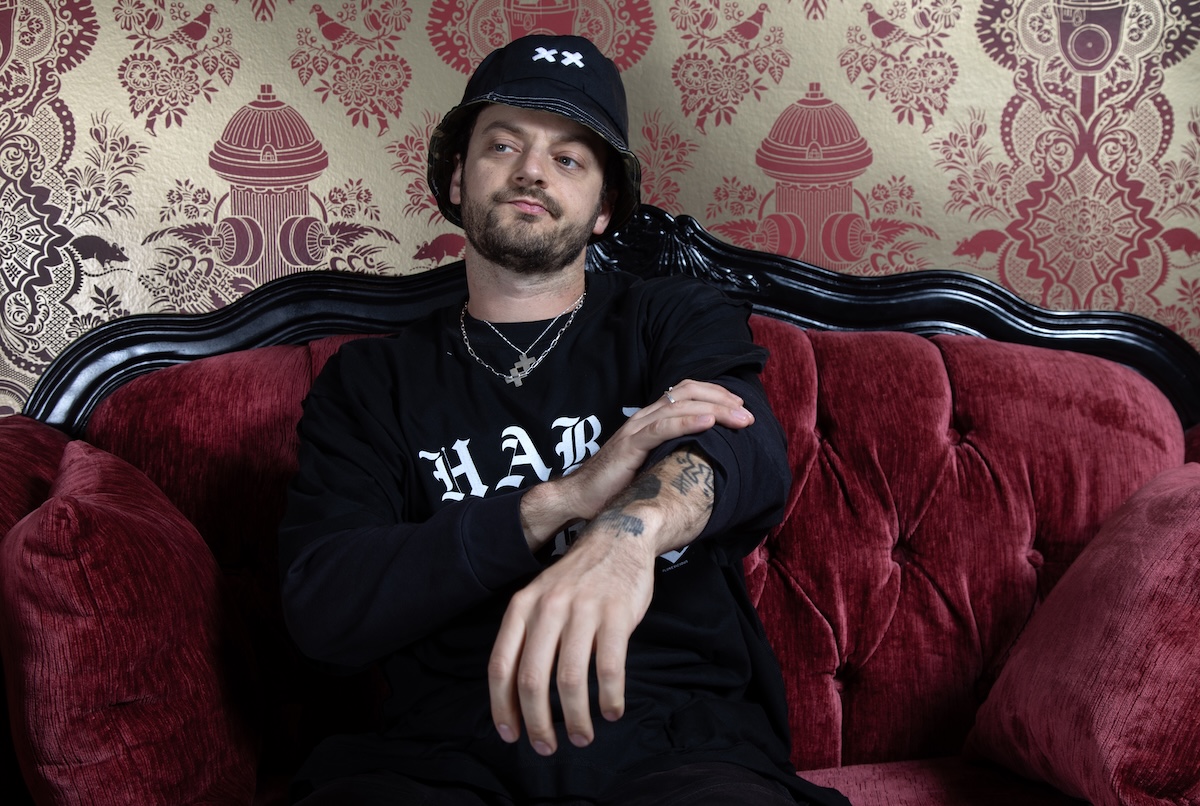
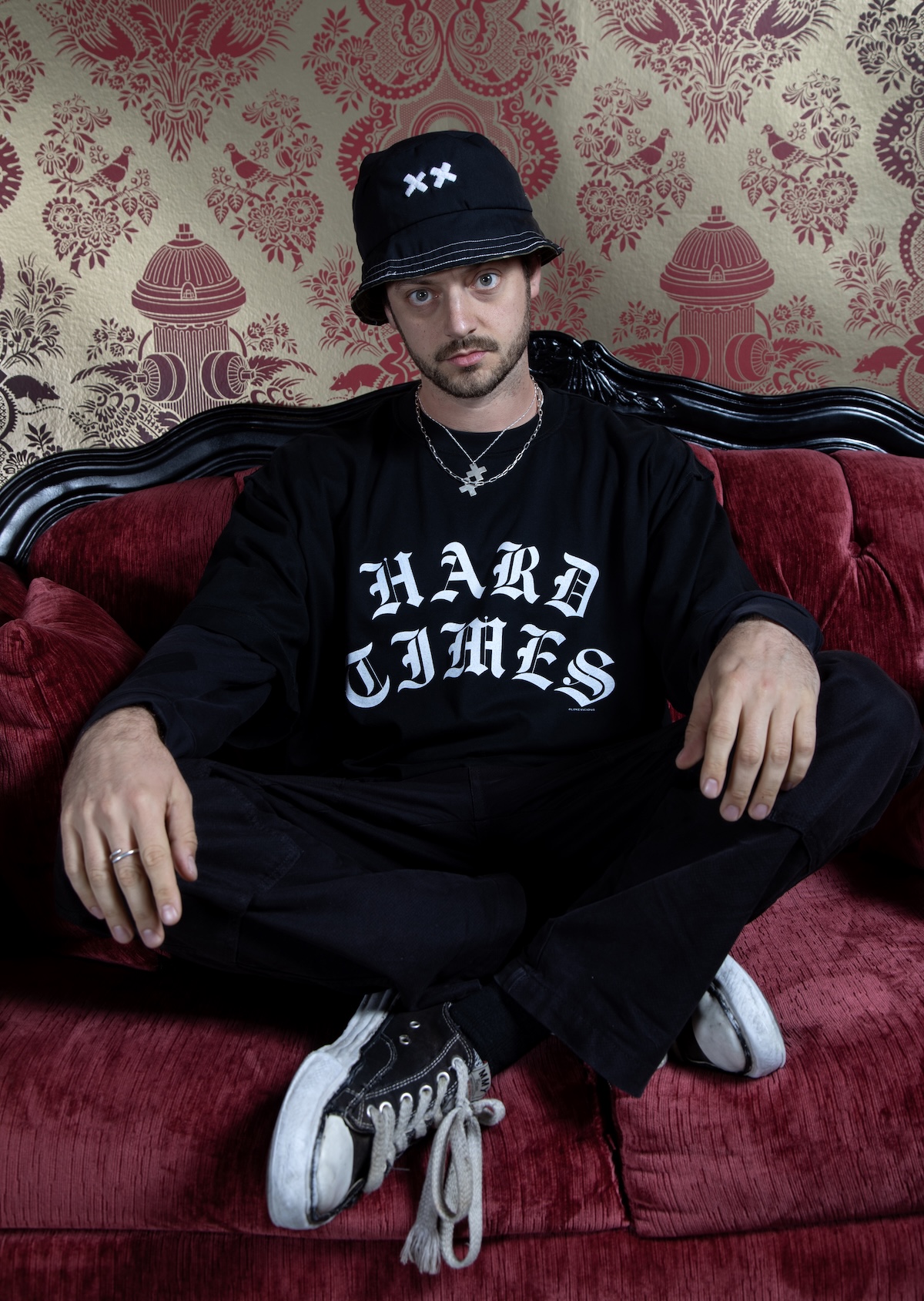
A week earlier, he’d headlined two nights in downtown L.A. at the Bellwether. Wearing a long-sleeved black T-shirt with “HARD TIMES” written in old English script, he was backed onstage by a wired three-piece band, and was barely contained behind the mic. At the end of January, the band’s tour continues across Europe, following the release of a new single, a cover of Bob Dylan’s “Masters of War.”
“I’m feeling like this version of Grandson is a version of myself that I don’t need to reinvent,” he says. “I’m in a place where I’m really doing something that I love and it feels like myself.”
In making Inertia, Benjamin found support among players and others for his louder and angrier direction, with stripped down instrumentation. He “committed to using few instruments, returning to the minimalism of a four-piece rock band,” the singer-rapper explains. “As soon as I started confidently saying, ‘I’m really a big fan of bands like Rage Against the Machine and Audioslave, and I want to make music like this,’ I had no shortage of people behind the scenes that were into it.”
Produced by Mike Crossey (Wolf Alice, Twenty One Pilots, the 1975), Inertia’s songs were built largely from the foundation of drummer Andrew Migliore, bassist Maxwell Urasky, and guitarist Leo Varalla, and they go hard.
“Little White Lies” rages about “a country falling apart at the seams.” The grim hip-hop track “Self Immolation” mixes scratches and crunching guitars with lyrics inspired by the story of Aaron Bushnell, a 25-year-old U.S. Air Force serviceman, who set himself on fire in front of the Israeli embassy in Washington, D.C. in 2024. The fatal act was in protest against the war in Gaza.
“I wanted to make something with some urgency,” says Benjamin, who also drew from the history of Buddhist monks in Vietnam in the 1960s who performed the same desperate act in protest against the government. “I wanted to cast a light on the seriousness of a person giving everything to what they believe in.”
The song “God Is An Animal” was originally written years earlier, when he “imagined doing a musical loosely inspired by George Orwell’s Animal Farm.” Set against an ominous rolling bassline, the track has a bit of RATM energy, as Grandson growls, “I don’t have a master / I ain’t waiting for my rapture / Don’t you see that we all captured? / Ain’t no heaven waiting for me after / So I’m gonna let it burn, burn.”
Near the album’s close is “Who’s the Enemy,” with searing messages on race and economic disparity in America: “Is it the color of his skin, or is it the tax bracket he’s in? … I’ll sit my ass down when that flag gets flown.” The closing verse comes from guest Bob Vylan, who raps: “My brother said they came and carved a line into the land / Packed up the oil and let him figure where he’d stand.”
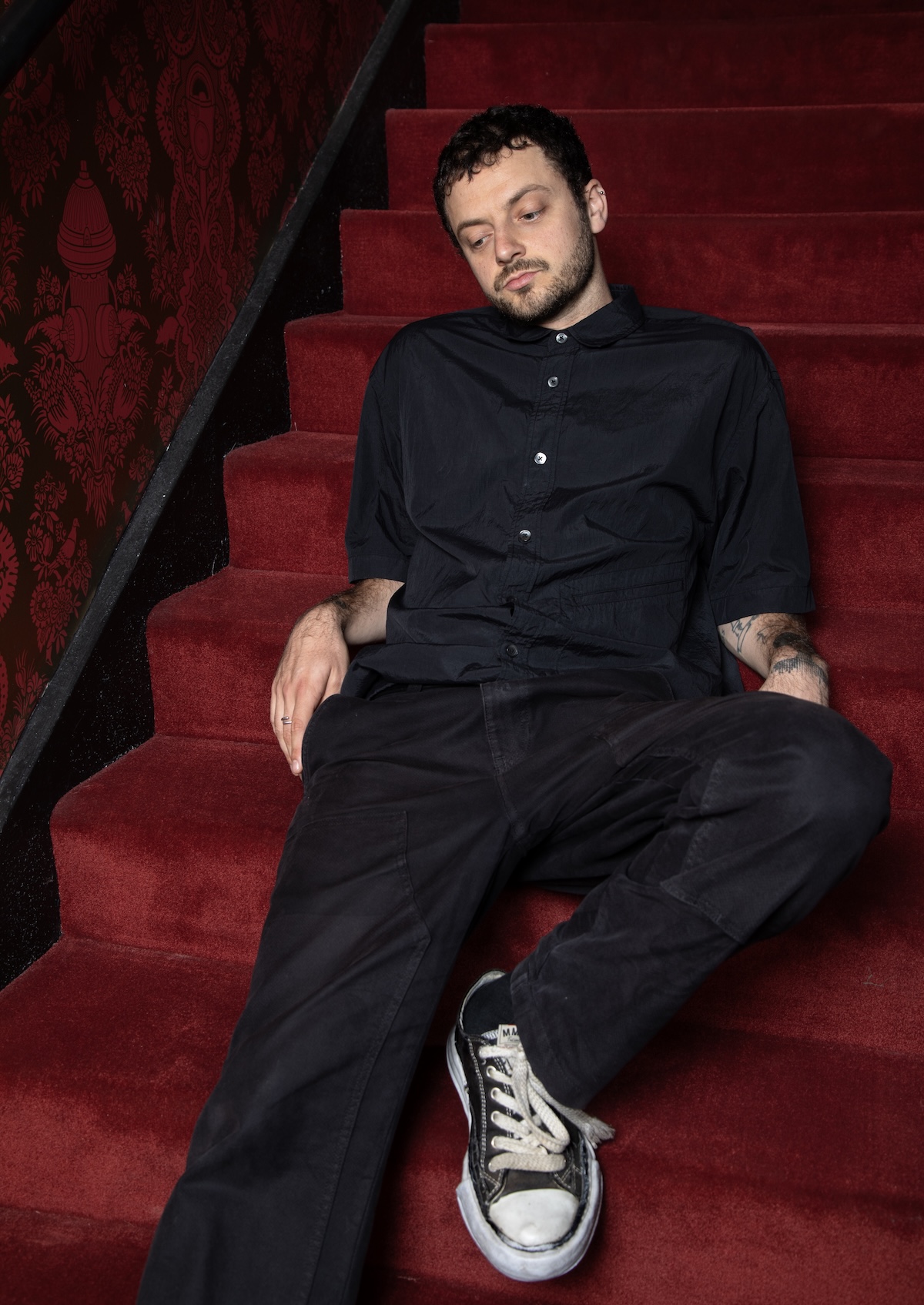
At the moment, Benjamin is sipping coffee in a plain white T-shirt, his dark hair and beard cropped short. His arms are covered with scattered tattoos, including a Keith Haring-style dancing figure that he got during the pandemic. “I missed making people dance,” Benjamin says of that time. “I missed live music, so I wanted something with that kind of wiggle to it.”
After about a decade in Los Angeles, he’s embraced life in the city. Earlier in the day before we spoke, he hiked through the wilds of Griffith Park, not far from his home. Born in New Jersey, but raised in Toronto, he first came west at age 20, traveling from Montreal, where he attended Concordia University. He had already been performing as a DJ, and already experimenting with rapping, when a young artist manager heard his music and brought him to L.A.
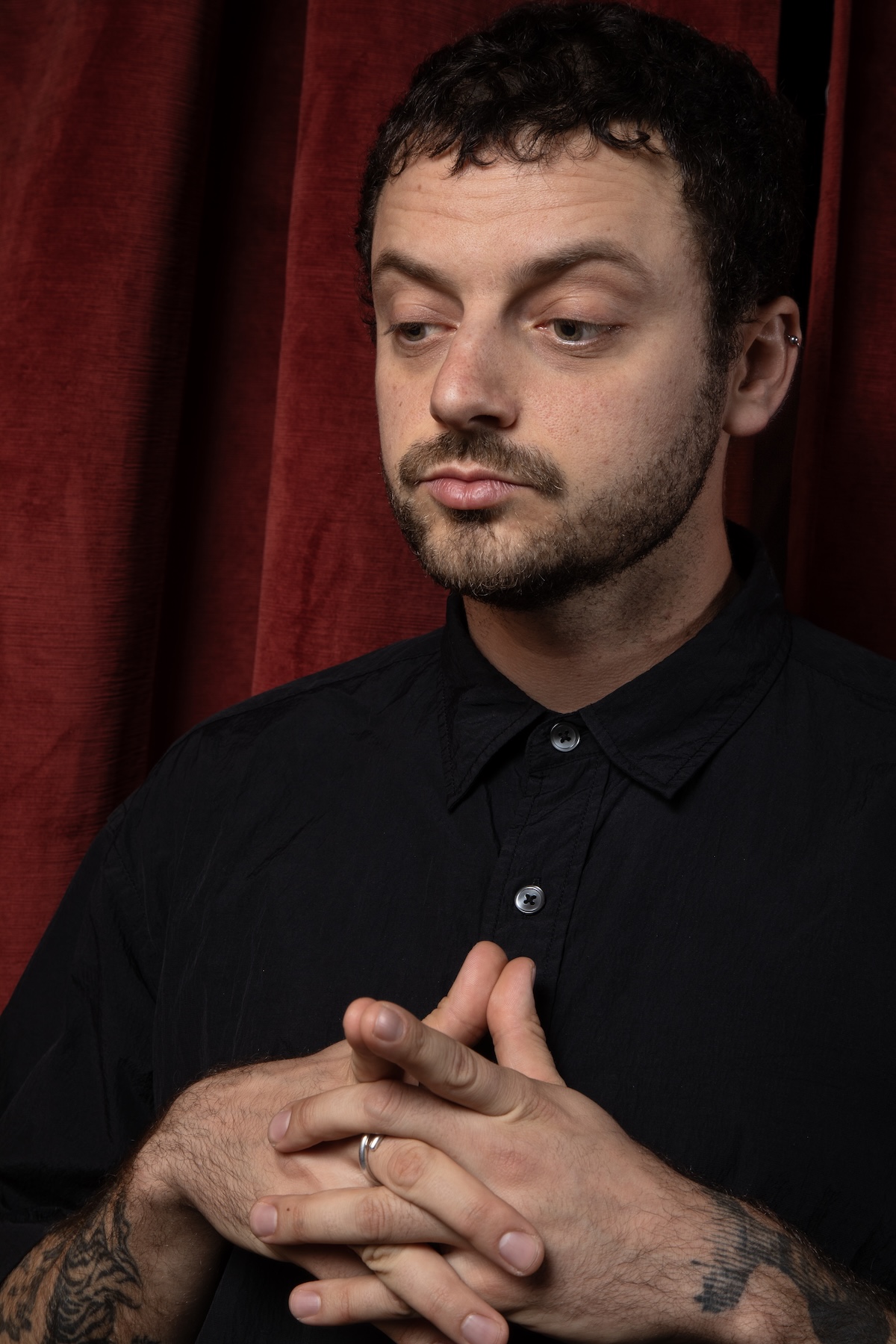
Benjamin took on the Grandson alias after attending his grandfather’s funeral and having a dream that he performed under that name. As his insignia, he adopted a pair of thick, lower-case X’s, which he still uses today.
During his earliest days in L.A., Benjamin also had his first Coachella festival experience as a fan, and was promptly busted for a fake ID. After two hours, he was allowed back into the fest. The cops kept the fake ID. “I am still looking for that mugshot,” he says with a laugh. “Somewhere in Indio, California, is a 20-year-old version of me stoned off my gourd, smiling ear to ear with some handcuffs on.” (In 2019, he finally made it onto the Coachella stage as a guest during DJ Kayzo’s set.)
After some initial singles, he first connected to a wider audience in 2017 with “Blood // Water,” the first single from Grandson’s debut EP, A Modern Tragedy Vol. 1. The track was a jarring collision of electronics and rock, with an intense vocal that left a mark. “That represented a real pivot into this kind of electronic rock and roll,” he says. “When you’re young, you have no money, you’re independent—I didn’t really have anything to lose by trying different things.”
In 2019, he released a smoldering, largely acoustic cover of Rage’s “Maria.” He’s since worked with the iconic band’s guitarist Tom Morello, releasing “Hold the Line,” a call to arms for workers on a picket line. On the track, Benjamin roars, “Nobody said it happens overnight / But if you’re looking for a sign / Remember everybody that stood up before you / Oh, they hold the line.”
“He’s a champion of rock music,” Benjamin says of Morello. “Not only that, but he’s a champion of protest. He assumes that responsibility for people. He’s happy to do it. Getting his co-sign early on really was cool because it allowed me to unapologetically be inspired by his work.
“There needs to be space for people to be mad about the state of the world, to feel rebellious, and then ultimately to feel hopeful and feel like music is in good hands. Rock and roll’s in good hands. I take a lot from his discipline and his commitment to doing it right.”
Grandson has also been championed by Linkin Park, who had Benjamin open in late 2024 when LP performed its first-ever public concert with singer Emily Armstrong at the Forum in Los Angeles. “I came in very much aware of the gravity of the situation,” he says of that high-profile gig, which began Linkin Park’s ongoing comeback story.
At other tour dates, Linkin Park has sometimes brought Benjamin up to sing on “One Step Closer,” stepping in for the late Chester Bennington. “It’s weird to be in their orbit. Because you forget for a second, and then you zoom out and you see the 18 semis and the 150 employees and the small economy boost in every single country they go to. And they’re the fucking real deal.”
As an artist also committed to the mingling of rap, electronics, and rock, Grandson has taken significant inspiration from Linkin Park and band leader Mike Shinoda. “I’ve watched him just be completely devoted to making art with his voice, making art with his pen,” he says of Shinoda.
As his first release since Inertia, Grandson continues his season of loud protest with the just-released single of “Masters of War,” covering Dylan’s devastating 1963 critique of the U.S. military industrial complex. The original is “probably my favorite that he ever did,” says Benjamin, whose take adds understated funk and moments of explosive guitar, with enough energy to fuel a mosh pit.
“We’re talking about war, so it’s got to end with chaos and cacophony,” he says. “We reimagined it. For me it’s about also putting my dick on the table and saying we can take a song as ambitious as this one that’s been done a million times over … and we’re going to do it really different.”
After finishing his tour dates this year, Grandson is looking to get back to making new music, he says. The singer wants to continue with the volatile standard set by Inertia.
“This version of myself is something that I’m feeling good about continuing to explore and express,” Benjamin says. “I don’t need to go away and get to the bottom of who I am next right now.”
Leave a comment